

THIS IS HOW ROAR EXPANSIVE CEMENT WORKS
The cement must be used in holes; pouring it into existing cracks in the stone or rock will not be effective.

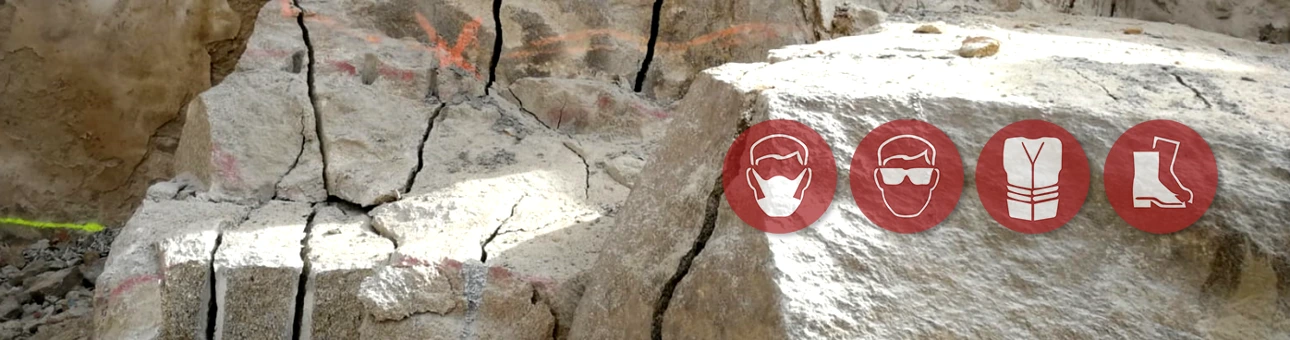
- Safety glasses must be worn at all times by personnel in the area. Hard hats and safety boots are a good idea on any construction or demolition site.
- When using the temperature chart, keep in mind that the temperature of the hole may be much higher than the surrounding air temperature if it is in the sun or affected by a nearby heat source due to machinery or from drilling the holes.
- Low temperature, hard stone, or holes that are too far apart can extend the breaking time. If after a full day no cracks appear, wait a little before thinking there is a mistake in the mix. TheROAR EXPANSIVE CEMENTcontinues to press for 24-48 hours.
- If when mixing the ROAR EXPANSIVE CEMENT it starts to emit steam in the bucket, add 2-3 litres of water, stir, clean, and dispose of the mixture. This happens because too much time has passed since the mixing began.
- If smoke or steam starts to come out when filling the holes, this is a sign that the mixture may burst. Immediately clear the area of people. The vapours are not dangerous or toxic in any way.
WHAT CAN CAUSE A BURST?
- Use ahole of too large a diameter.
- Usewater that is too hotin the mix. See temperature table.
- Usevery little water, especially when the stone or cement is at a temperature above 22ºC.
- Too much time elapsed between the start of the mix and the fillingof the holes with that mix.
- Guessing the temperatureinside the hole instead of measuring it.
- Guessing the temperature of the waterinstead of measuring it.
- Holesthat are veryshallow. The depth should be 4 times the diameter of the hole or more.
- Allow thedust to be too hotbefore mixing it with water.
- Holes drilled very close, 25 cm, in soft stone or cement, in hot weather.
- Thebest drill diameter is 38 mm
- Blowouts usually do notoccur after 3 hoursafter filling the holes.
HANDLING AND STORAGE
Precautions for safe handling.
- Do not handleor store nearfood, drinksortobacco.
- EXPANSIVE CEMENT ROAR is a highly alkaline product, the pH reaches 13 after contact with water andcan cause severe irritationto mucous membranes, especially the eyes.
- Wearsafetyglasses,rubbergloves and a helmet during the mixing and pouring process of ROAR EXPANSIVE CEMENT.
- Wear adustmask when using ROAR EXPANSIVE CEMENT, especially in areas where ventilation is poor such as tunnels or mines.
- Do not be close and above alldo not bring your headwithin at least 3 hours after filling the holes.
- Keep people away from the areaafter filling the holes.
- Cover the holes from rain or direct sunlightonly with a cloth or a tarpaulin that does not retain heat
- Skin contactwith ROAR EXPANSIVE CEMENT must beremoved with large amounts of cold waterquickly after contact.
- Eye contactwith ROAR EXPANSIVE CEMENT must beremoved with large amounts of cold water immediately and without rubbing. Seek medical attention promptly.
- Keepout of reach of children.

CAUTION NOTE
- Expansive demolition agents involve a phenomenon known as 'blow-out-shot' or blowout. This occurs if the mixed powder reaches too high a temperature and reacts with water too quickly for the material to expand laterally.
- The temperature can be higher than the boiling point before the water is chemically combined with ROAR EXPANSIVE CEMENT. This can result in steam formation, which will cause the ROAR EXPANSIVE CEMENT to burst from the hole with a sudden force.
- To avoid bursting, the instructions regarding water temperatures, mixtures, and hole sizes must be followed. Always wear safety glasses, and typically use holes with a diameter of 38 mm.
- Clean all dust and dirt from the holes after drilling and keep the ROAR EXPANSIVE CEMENT cool before use.
Fire prevention measures:
- Not applicable
Measures to prevent the formation of suspended particles and dust:
- Do not sweep. Use dry cleaning methods that do not raise dust, such as vacuum or extraction systems.
Measures to protect the environment:
- No special measures are required.
Control parameters.
Name-limit value
The risk assessment for the different environmental compartments is based on the effect on the pH of the water. Possible variations in the pH of surface water, groundwater, and wastewater effluents should not exceed a value of 9.
Exposure controls.
Appropriate technical controls.
Measures to reduce the formation of suspended particles and the spread of dust, such as: dusting, vacuum systems, and dry cleaning methods that do not raise dust.
PROC exposure scenarios* Exposure Localised controls Efficiency
Individual protective measures, such as personal protective equipment.
Individual protective measures, such as personal protective equipment.
General:
Do not eat, drink or smoke while working with cement to avoid contact with skin or mouth. Once work with cement or materials containing it is finished, workers should wash or shower or apply moisturising creams immediately.
Remove any soiled clothing (clothes, footwear, watches, etc.) and clean it before reusing.
Eye/face protection:
Use approved glasses or certified protective eyewear.
Skin protection:
Use waterproof gloves resistant to abrasions and alkalis with a cotton inner lining, boots, long-sleeved protective clothing, as well as skin care products (including protective creams) to protect the skin from prolonged contact with wet cement.
Special care should be taken to prevent cement dust from entering safety footwear.
Respiratory protection:
When a person is potentially exposed to dust concentrations above the permitted limits, appropriate respiratory protection should be used. The type of respiratory protection should be suitable for the concentration of particles present and in accordance with the standards set out in the harmonised UNE regulations.PROC exposure scenarios* Exposure
Considerations regarding disposal.
Methods for waste treatment
- Do not pour cement into drains or surface waters.
Product – unused residues or spills of dry material
- Collect the dust. Label the containers.
Product – set cement after addition of water
Dispose of in accordance with local legislation. Avoid discharging into sewer systems. Dispose of set product as concrete waste. Set cement is an inert and non-hazardous waste.
Packaging waste
Manage completely empty packaging waste in accordance with local legislation.
Not relevant.